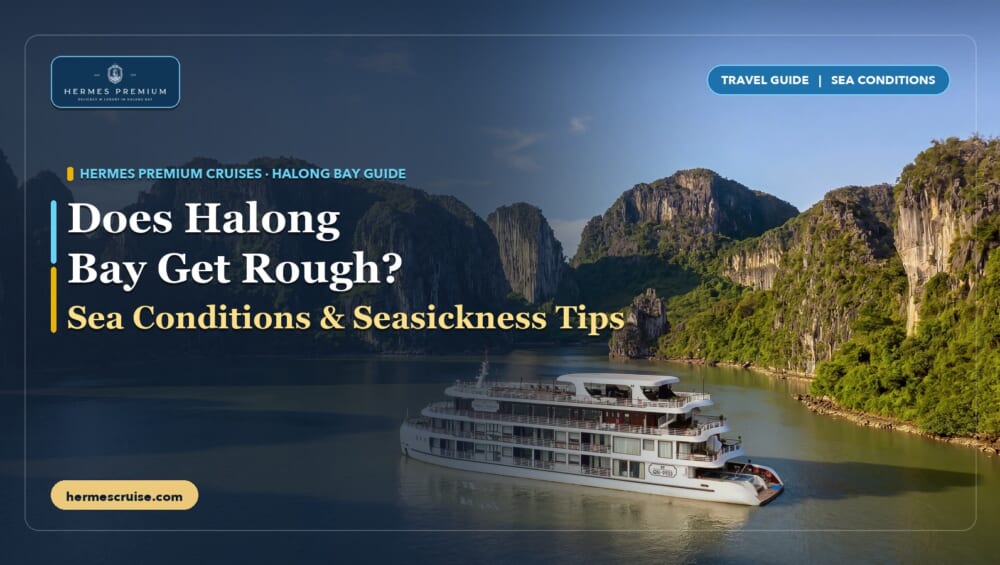
Halong Bay seasickness is one of the most common questions before an overnight cruise, and it usually arrives in a single phrase: does Halong Bay get rough? The answer is reassuring. The cruising area is a sheltered field of limestone islands rather than open ocean, and Vietnam’s tourism authority describes autumn and spring as clear, calm days for cruising.
This guide sets out what published sources say about conditions in the bay, which months are calmest, how maritime authorities coordinate daily forecasts, and which steps the NHS and the US CDC recommend for anyone sensitive to motion. It also explains how our two sister ships — the 18-cabin Hermes Cruises and the 26-cabin Hermes Premium Cruises — pace their itineraries around tide and weather.
Halong Bay seasickness is rarely a concern, because cruises sail along sheltered channels between some 1,600 limestone islands rather than across open sea, and Vietnam’s tourism authority calls autumn and spring days calm for cruising. On both the 18-cabin Hermes Cruises and the 26-cabin Hermes Premium Cruises, wide steel hulls and short scenic transfers keep motion minimal.
Does Halong Bay Get Rough? Understanding Halong Bay Seasickness
Halong Bay is naturally calm because the route winds between limestone islands that act as a breakwater across the cruising lanes. This guide does not quote wave heights, because the sources we opened publish none for the cruising area.
What the sources do give is the layout of the bay. IUCN’s World Heritage Outlook counts some 1,600 islands and islets in the Gulf of Tonkin, and Vietnam’s national tourism website says autumn and spring bring clear, calm days for cruising.
| Question | What the sources say | What it means for you |
|---|---|---|
| How sheltered is the route? | IUCN counts some 1,600 islands and islets | Much of the cruise runs between sheltered limestone islands |
| Which months are calm? | Vietnam’s tourism site: autumn and spring bring clear, calm days for cruising | Ideal conditions for deck relaxation, kayaking and cave visits |
| How is weather monitored? | VietNamNet reports that Quang Ninh coordinates with the National Center for Hydro-Meteorological Forecasting | Real-time weather bulletins guide every daily departure |
| Who sets daily sailing clearances? | The Quang Ninh Inland Waterway Port Authority issues daily clearances from Tuan Chau | Every cruise sails on verified, calm bay routes |
🌿 Nature Note:
IUCN describes the bay as marine-invaded tower karst: limestone towers shaped by rain and later flooded by the sea. Where the islands part and the horizon opens, you will notice more breeze and a little more movement.
Which Months Are Calmest on the Bay?
Autumn and spring are described as the calm, clear months, and summer carries the chance of storms. Vietnam’s tourism authority lists September to November as the best time to visit, while the UK government says tropical cyclone season normally runs from May to November.
The two statements overlap in autumn, so a flexible mindset helps more than a perfect month. Winter brings what the tourism site calls a light mist over the bay, along with cooler, drier air. Mist changes what you see, not how the boat moves.
Our guide to the best time to visit Halong Bay compares the whole year, and the Halong Bay in December guide covers the coolest part of the season. Treat the calm-days description as a tendency, not a promise.
How Maritime Forecasting and Fleet Design Support a Smooth Sailing
Provincial maritime authorities coordinate real-time weather bulletins for the bay, and the crew adjusts daily excursion timing to match the calmest tide windows. Both Hermes Cruises and Hermes Premium state that itineraries may be adjusted for weather and tidal conditions so every stop runs comfortably.
As VietNamNet reported, Quang Ninh province works with the National Center for Hydro-Meteorological Forecasting and the Institute of Earth Sciences to deliver early, localized weather updates across Halong Bay, while the entire overnight fleet uses AIS and GPS positioning connected to the port authority.
The UK government’s travel advice for Vietnam advises anyone joining a boat to attend the full safety briefing and check where life jackets are stowed. On both ships, the Cruise Manager introduces the itinerary and safety rules at the welcome briefing after boarding at 12:00. Our Halong Bay cruise safety guide covers the full onboarding protocol.
⚓ On the Water:
Tide and breeze shape the finest details of a bay itinerary, such as the best hour to glide through a low arch like Luon Cave. The programme times are the framework; the crew’s local updates ensure you visit each stop at the smoothest water level.
How to Prevent Halong Bay Seasickness: Tips from the NHS and CDC
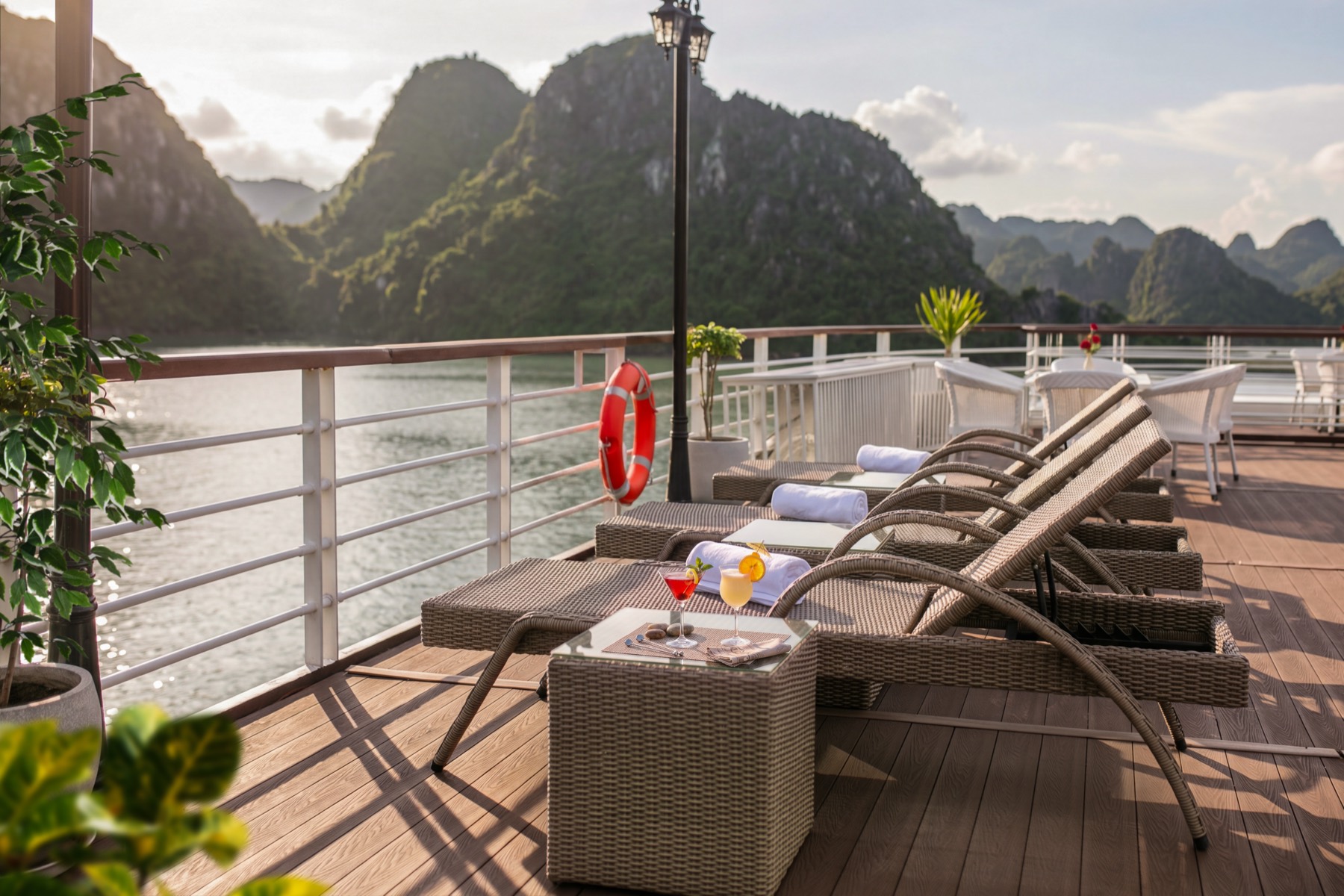
Sit where movement is least, keep your eyes on a fixed point such as the horizon, get fresh air and avoid heavy meals or alcohol before you travel. These steps come from the NHS and the CDC, and they work best when you start before you feel unwell.
The NHS guidance on motion sickness explains the cause as a mismatch: waves under a boat make the inner ear send signals that do not match what your eyes see. The CDC Yellow Book describes the same conflict.
| Tip | What the guidance says | How it applies on a cruise |
|---|---|---|
| Choose your spot | NHS: sit in the middle of a boat. CDC: avoid locations of maximum motion, such as the bow | Spend time in open-air areas and ask the crew where movement is least |
| Fix your gaze | NHS and CDC: look at the horizon | The islands give you a steady reference point from the Sundeck |
| Watch food and drink | NHS: avoid heavy meals, spicy food and alcohol shortly before or during travel | Go easy before the tender, the caves and kayaking |
| Limit screens | NHS: avoid reading and devices | Look up between photographs |
| Rest well | CDC: lack of sleep can worsen symptoms | Day 2 begins with Tai Chi at around 06:00, so an early night helps |
| Ask about medicine | NHS: a pharmacist can advise; CDC: medicines work best before symptoms start, and drowsiness is the commonest side effect | Speak to a pharmacist or doctor before the trip |
The evidence for popular remedies is mixed. The NHS suggests ginger and notes that acupressure bands do not work for everyone, while the CDC calls the evidence for ginger weak and contradictory. This article is not medical advice, so ask a doctor or pharmacist what suits you, especially for children.
🧭 Good to Know:
If you know you are sensitive, say so when you book and again at the 12:00 briefing. Spend sailing time on deck rather than in your cabin, and keep a water bottle with you; each cabin has two complimentary bottles per day.
What a Hermes Premium Sailing Feels Like: Ship, Cabins and Activities
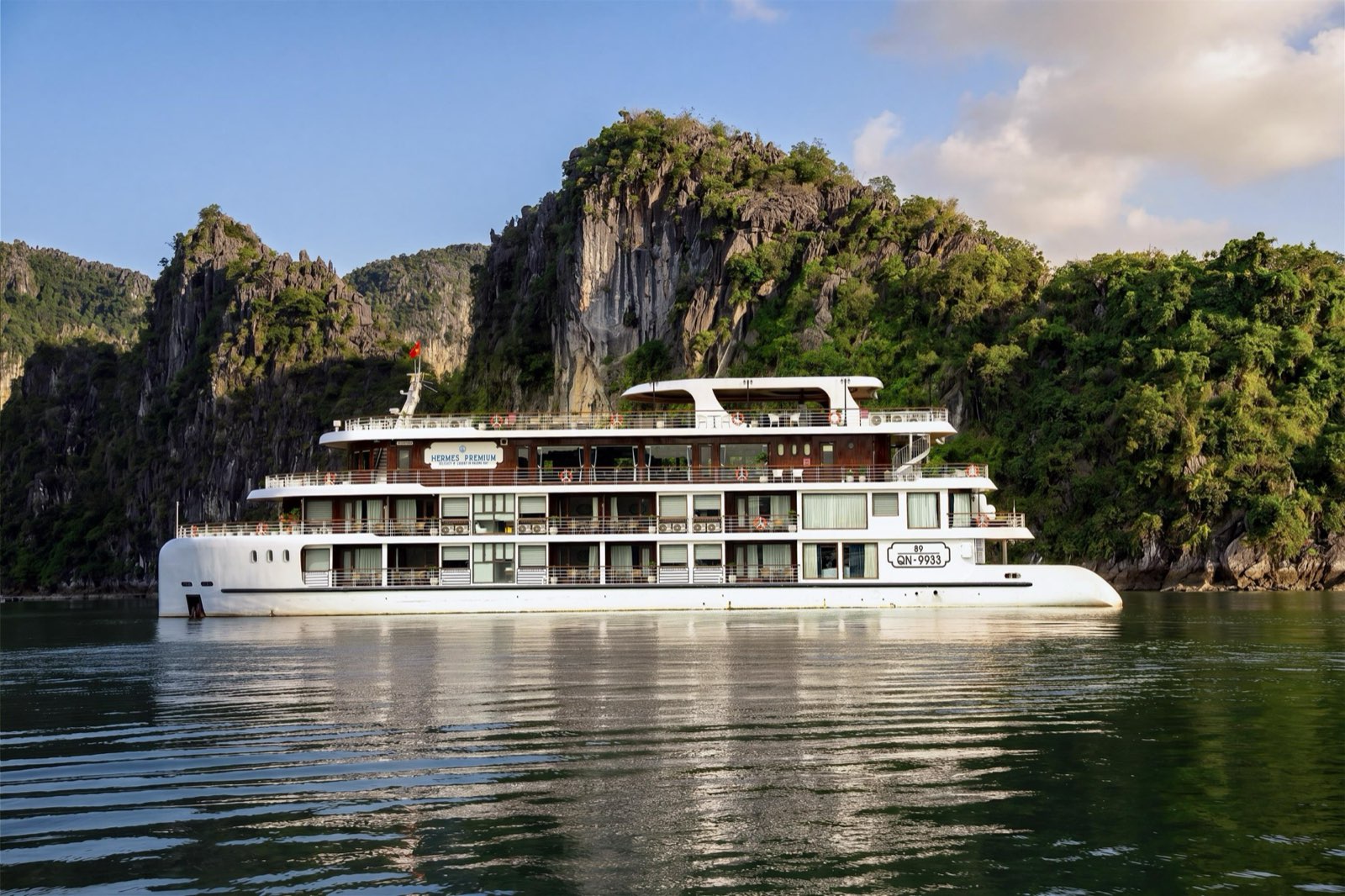
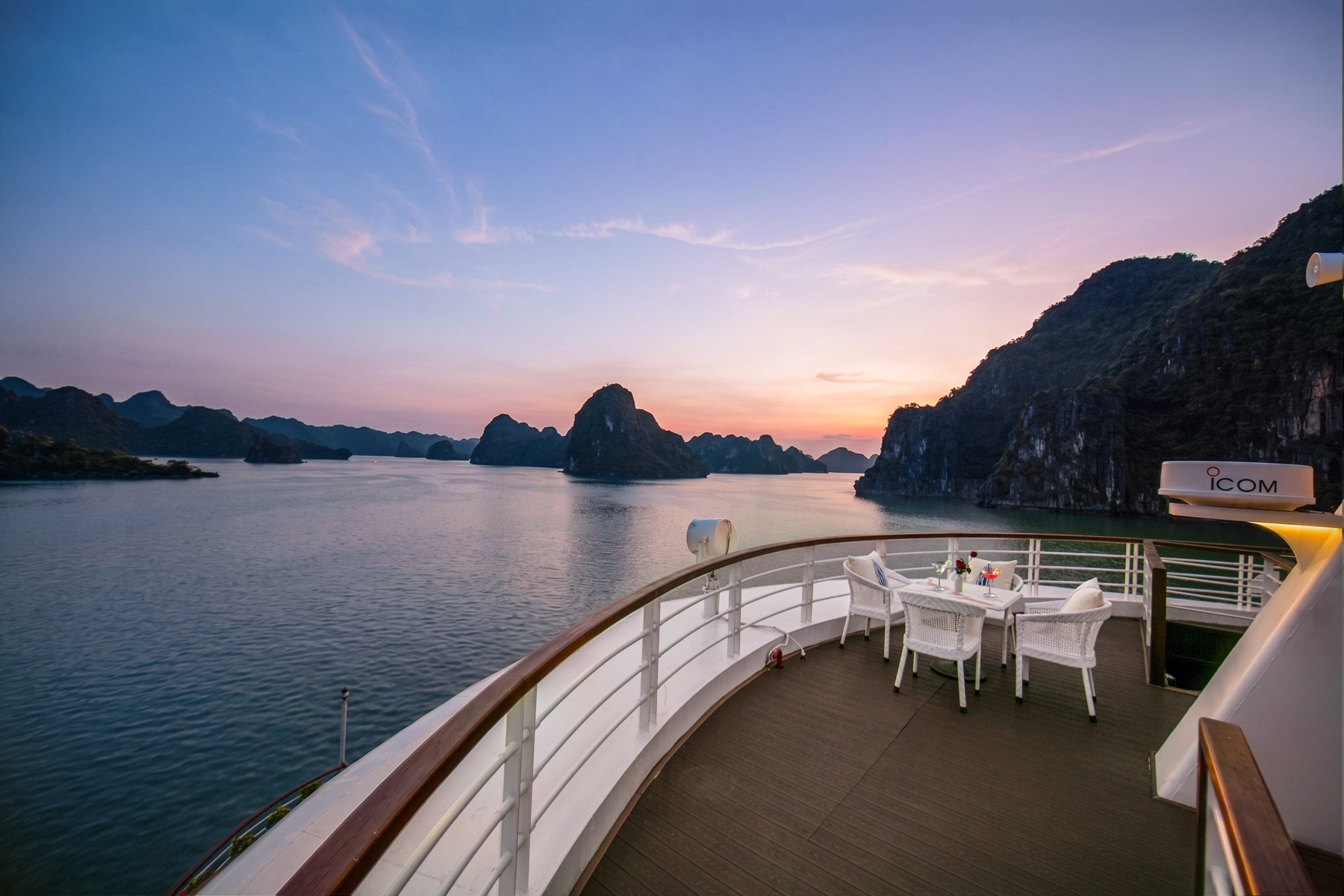
Hermes Premium is a 57 m ship with 26 cabins and room for up to 89 guests, and its programme is built around short moves between the ship, the caves and the beach. Most of the day is spent either on board or on short transfers.
On the 2 Days 1 Night programme, the transfer boat leaves Tuan Chau at 12:00, lunch is served on board and the cave stops begin at 14:30; the 2 Days 1 Night itinerary lists each step. The ship, described on the Hermes Premium Cruises page, is 13.85 m wide and its restaurant seats 48 guests.
| Part of the day | When | What to consider if you are prone to seasickness |
|---|---|---|
| Transfer boat to the ship | 12:00, Day 1 | A short ride; sit down, look ahead and breathe slowly |
| Sailing through the bay | After boarding, Day 1 | Time on the open deck, with the islands as a reference |
| Luon Cave | 14:30, Day 1 | Kayak, or a bamboo boat paddled by locals |
| Evening on the Sundeck | 20:00, Day 1 | Open-air music and views; layers help |
| Titov Island | 07:15, Day 2 | Climb 424 steps, or swim at the beach in good weather |
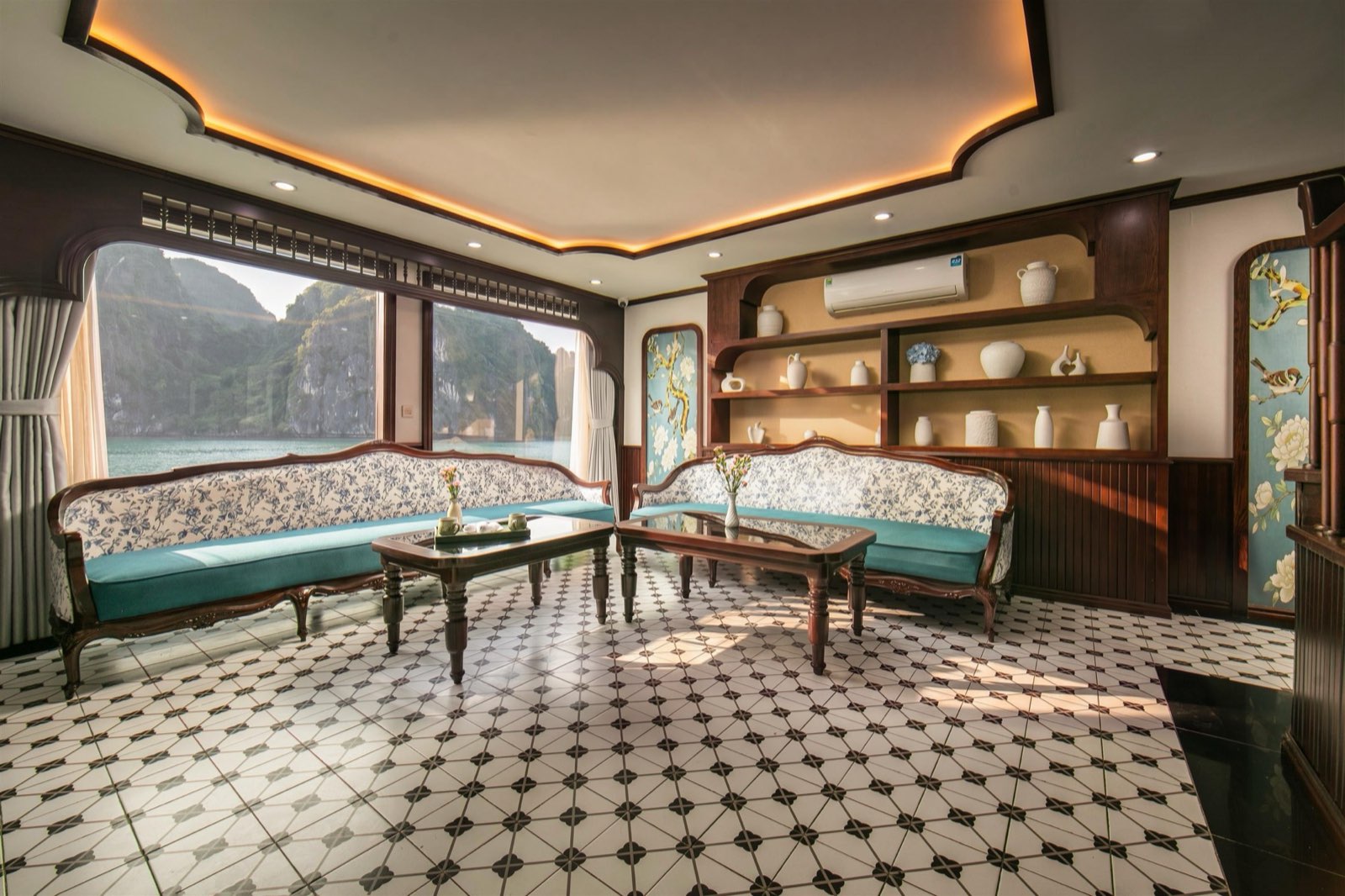
The cabins sit on the first, second and third floors on Hermes Premium, and on the first and second floors on our 18-cabin sister vessel Hermes Cruises — where every suite on the Hermes Cruises cabins & suites page ranges from 28 m² to 64 m² with a private balcony and jacuzzi bathtub, and the 2 Days 1 Night itinerary on Hermes Cruises visits Luon Cave and Titov Island on Day 1 afternoon and Sung Sot Cave on Day 2 morning. If you are sensitive to motion, mention it when you book and ask which lower-deck or mid-ship cabin the team suggests. Our Luon Cave guide explains how the tide shapes the lagoon visit.
Who Should Plan Extra for Seasickness?
People with a history of migraine, vertigo or vestibular (inner-ear) disorders are more prone to motion sickness, and the CDC says susceptibility peaks in children between about 7 and 12. If that describes your group, plan a little more before the day.
- Adults who are prone. Follow the table above and speak to a pharmacist or doctor before travelling.
- Families. The CDC suggests trying behavioural measures first for children, such as fresh air, music and distraction, and warns that some medicines can over-sedate young children. Ask a doctor before giving any.
- Active travellers. Kayaking is optional: the bamboo boat at Luon Cave is paddled by locals. The kayak guide explains what to expect on the water.
- Anyone worried about weather. Ask the reservations team how changes are handled on your dates.
Frequently Asked Questions (FAQs)
Is Halong Bay rough enough to cause seasickness?
Usually not, but conditions change by day. The route runs between some 1,600 islands and islets, and Vietnam’s tourism authority describes autumn and spring as calm for cruising. Wind, tide and storms can still change the water. If you are prone to motion sickness, take the precautions in this guide.
When is the sea calmest in Halong Bay?
Autumn and spring are described as the clear, calm seasons. Vietnam’s tourism authority gives September to November as the best period. Summer carries the chance of storms, and the UK government says cyclone season normally runs from May to November. No month is a guarantee, so check the forecast before you travel.
Can weather or tide adjust my cruise timetable?
Yes, the crew can fine-tune the sequence of stops. Both Hermes Cruises and Hermes Premium state that itineraries may be adjusted for weather and tidal conditions so that cave and island visits take place in comfortable conditions. Ask the team when you book how seasonal schedules work on your dates.
What should I do if I feel seasick on board?
Move to fresh air, look at the horizon and breathe slowly. The NHS suggests fresh air, slow breathing and avoiding screens or reading. Tell a crew member how you feel so they can help. If symptoms are severe or you are unsure what to take, ask a doctor or pharmacist.
Should I take seasickness medicine before a Halong Bay cruise?
That is a question for your doctor or pharmacist. The CDC notes that medicines generally work best when taken before symptoms begin, and that drowsiness is the most common side effect. The NHS says a pharmacist can recommend the best option. We cannot advise on specific medicines.
Are children more likely to get seasick?
They can be. The CDC says susceptibility rises from early childhood and peaks at about 7 to 12 years, and it advises trying behavioural measures first. Fresh air, music and distraction help, and a doctor should guide any medicine because some can over-sedate young children.
If you would like to know how cabin locations and seasonal schedules work on your dates, the team can answer at [email protected], or you can start from the Hermes Cruises reservation page and the Hermes Premium reservation page.